
Loading

Network stability, dynamics and spatial games
Description:
NetworGame,
a tool for the analysis of a large variety of spatial games on model and real world networks including the option for individual starting strategies for any network nodes.More...
This complex project is aimed to understand the rules of network evolution and the emergence of network complexity. In hope to find key aspects in this multi-task process, we combine three independent, but interrelated approaches.
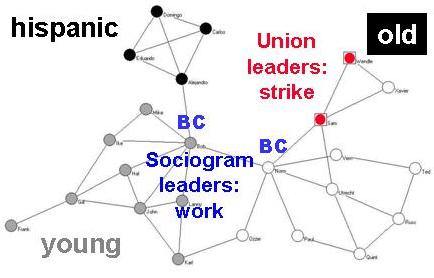
- First, we keep in mind our observation, which showed the generality of the stabilizing role of weak-links in a wide variety of real world networks and try to give a more exact meaning of this statement.
- Second, we analyze the development of cooperation in repeated games between agents situated on nodes of various networks using our refined knowledge on the topology of complex and large real world networks.
- Third, we develop analytical tools to follow network dynamics and evolution in hope to link these processes to the emergence of game strategies.
Link to the description and download of the NetworGame program package.
Publications:
- Szalay, K.Z., Nussinov, R. and Csermely, P. (2014) Attractor structures of signaling networks: Consequences of different conformational barcode dynamics and their relations to network-based drug design. Molecular Informatics, 33: 463-468. IF: 2.3 http://arxiv.org/abs/1404.4515 Download it!

- Simko, G.I. és Csermely, P. (2013) Nodes having a major influence to break cooperation define a novel centrality measure: game centrality. PLoS ONE 8, e67159, IF: 3.7 http://arxiv.org/abs/1304.3796
Download it! - Farkas, I.J., Korcsmáros, T., Kovács, I.A., Mihalik, Á., Palotai, R., Simkó, G.I., Szalay, K.Z., Szalay-Bekő, M., Vellai, T., Wang, S. and Csermely, P. (2011) Network-based tools in the identification of novel drug-targets. Science Signaling 4, pt3. Download the paper!
Download the slideshow! - Csermely, P., Palotai, R. and Nussinov, R. (2010) Induced fit, conformational selection and independent dynamic segments: an extended view of binding events. Trends Biochem. Sci. 35, 539-546 -- a cover story. Download it!
Visit it at arxiv.org! - Antal, M.A., Böde, C. and Csermely, P. (2009) Perturbation waves in proteins and protein networks: Applications of percolation and game theories in signaling and drug design. Curr. Pept. Prot. Res. 10, 161-172 Download it!
Visit it at arxiv.org! - Wang, S., Szalay, M.S., Zhang, C. and Csermely, P. (2008) Learning and innovation expand cooperative network topologies.PLoS ONE 3, e1917
Download it! - Kovacs, I.A., Szalay, M.S. and Csermely, P. (2005) Water and molecular chaperones act as weak links of protein folding networks: energy landscape and punctuated equilibrium changes point towards a game theory of proteins. FEBS Letters, 579, 2254-2260 IF: 3.5 Download it!
Visit it at arxiv.org!- Received a 2-star recommendation by Faculty of 1000 (F1000 Prime)

- Received a 2-star recommendation by Faculty of 1000 (F1000 Prime)
- Csermely, P. (2006) Weak Links, Springer Verlag Download it!
- Csermely, P. (2004) Strong links are important – but weak links stabilize them. Trends in Biochem. Sci. 29, 331-334 Download it!

Published by the LINK-Group | Editor: Péter Csermely | Last updated on 10 09 2013
Questions | Address | Design and maintenance | Visitors since 7th July 2004:
Questions | Address | Design and maintenance | Visitors since 7th July 2004: